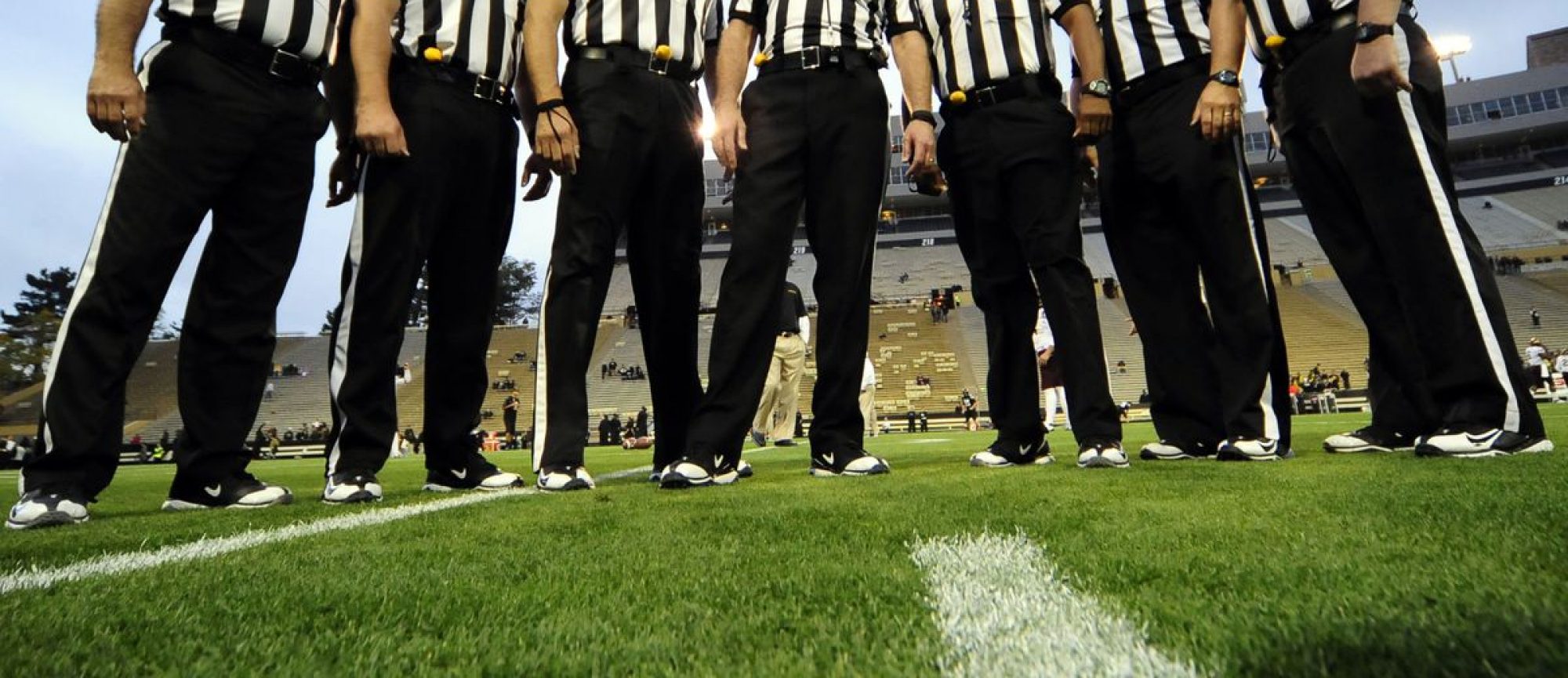

Formerly known as “philosophies”, the following standards have been adopted for CFOA games.
I. Ball Spotting
1.
The ball can be placed on a yard line to begin the next series after a change of possession.
2.
Example: If a punt return ends between the 33- and 34-yard lines, move the ball forward to the 34-yard line.
II. Line of Scrimmage
1.
Officials will work to keep offensive linemen legal and will call a foul only when it is obvious or when repeated warnings are ignored. Do not wait until the fourth quarter to enforce the rule.
2.
Do not be technical when determining whether an offensive player who is a wide receiver or slot back is off the line of scrimmage. When in question, it is not a foul.
3.
Wide receivers or slot backs lined up outside a tight end will be ruled on the line of scrimmage, thereby covering the tight end, if there is no stagger between their alignments. When in question, the tight end is not covered.
4.
Formations used during the execution of a trick or unusual play receive the highest degree of scrutiny and should be completely legal.
III. Counting Players
1.
When there are fewer than 11 players: palms down, below the belt.
2.
When there are more than 11 players: hamster wheel or finger whirl.
IV. Bean Bags
1.
Fumbles: Officials shall drop the bean bag only when they see the ball fumbled, not simply when they see the ball loose.
2.
Punts: Officials shall drop the bean bag at the spot where the kick ends or at the spot of first touching.
3.
Be accurate. You are marking a potential enforcement spot.
4.
Do not drop your bean bag after an interception, except when inside the 5-yard line to mark the spot of momentum.
5.
Use a bean bag behind the line of scrimmage to help mark intentional grounding by the passer.
V. Defensive Pass Interference
1.
Both offensive and defensive players have an equal opportunity to catch a forward or backward pass.
2.
Actions that constitute defensive pass interference include, but are not limited to:
a.
Early contact by a defender who is not playing the ball, provided the other requirements for defensive pass interference have been met. Make sure the receiver is not a potential blocker. This applies regardless of how deep the pass is to the receiver.
b.
Playing through the back of a receiver in an attempt to make a play on the ball.
c.
Grabbing and restricting a receiver’s arm(s) or body in a manner that restricts the receiver’s opportunity to catch a pass.
d.
Extending an arm across the body of a receiver—an “arm bar”—and restricting the receiver’s ability to catch a pass, regardless of whether the defender is looking for the ball. This also includes cutting off or riding the receiver out of the path to the ball by making contact without playing the ball.
e.
Hooking and restricting a receiver while attempting to get to the ball in a manner that causes the receiver’s body to turn before the ball arrives.
VI. Not Defensive Pass Interference
Actions that do not constitute defensive pass interference include, but are not limited to:
1.
Tangled feet when both players are looking back at the ball or neither player is looking back at the ball.
2.
Contact when either player is making a legitimate play on the ball, or shoulder-to-shoulder contact when players are coming from different angles.
3.
Contact occurring so close to the touching of the pass that it is considered “bang-bang” pass interference. This should not be called.
4.
A defender placing a hand on a receiver’s body without initiating a turn, twist, pull, or push.
VII. Offensive Pass Interference
Actions that constitute offensive pass interference include, but are not limited to:
1.
Initiating contact with a defender by shoving or pushing off, thereby creating separation in an attempt to catch a pass.
2.
Driving through a defender who has established a position on the field.
3.
Blocking beyond the line of scrimmage during a pass, including a “screen” or “pick” play.
VIII. Not Offensive Pass Interference
Actions that do not constitute offensive pass interference include, but are not limited to:
1.
A screen pass where the ball is overthrown behind the line of scrimmage but subsequently lands beyond the line of scrimmage and linemen are blocking downfield, unless the blocking prevents a defensive player from catching the ball.
2.
A pick play when the defensive player is blocking the offensive player when the pick occurs.
3.
After any forward pass has been touched by Team B, the conditions for pass interference expire.
IX. Other Passing Situations
1.
When in question regarding action against the passer, it is roughing the passer if the defender’s intent is to punish.
2.
If an interception occurs near the goal line—inside the 1-yard line—and there is a question as to whether possession was gained in the field of play or in the end zone, rule the play a touchback.
X. Backward Pass
1.
When in question, the pass is forward, not backward.
2.
When the quarterback’s hand starts forward with the ball, rule the pass forward even if the quarterback is contacted and the ball subsequently travels backward.
XI. Catch
1.
If the process of the catch includes going to the ground, the receiver must maintain possession of the ball when contacting the ground to be awarded a catch. The ground can cause an incompletion.
2.
These requirements are the same for interceptions and fumble recoveries.
3.
There is a difference between the ball moving while remaining within the receiver’s control and the ball moving because of a loss of control.
4.
If the receiver is contacted simultaneously with, or immediately after, controlling the ball with one foot down and then loses possession, rule the pass incomplete.
5.
A play that would be ruled a catch/fumble in the field of play would be ruled a catch/touchdown in the end zone.
XII. Blocking
1.
Takedowns at the point of attack, in the open field, or within the tackle box that affect the result of the play should be called.
2.
If there is potential offensive holding but the action occurs clearly away from the point of attack and has no effect—or could have no effect—on the play, offensive holding should not be called.
3.
If there is potential defensive holding but the action occurs clearly away from the point of attack and has no effect—or could have no effect—on the play, defensive holding should not be called.
4.
For blocks in the back, if one hand is on the number and the other hand is on the side, and the initial force is on the number, it is a block in the back. The force of the block may be slight and still constitute a foul if the contact propels the player past the runner.
5.
A grab of the receiver’s jersey that restricts the receiver and takes away the receiver’s feet should be defensive holding if the other criteria are met. It could also constitute defensive pass interference.
6.
Holding can be called even if the quarterback is subsequently sacked, as it may be the other half of an offsetting foul.
7.
An illegal block in the back can be called on fair catches only if the point of attack is involved or the action constitutes a personal foul.
8.
Rarely should holding be called on a double-team block unless there is a takedown or the defender breaks the double team and is pulled back.
9.
When in question as to whether an illegal block occurred in the end zone or in the field of play, rule that it occurred in the field of play.
XIII. Kicking
1.
The kicker’s restraining line for onside and short pooch kickoffs should be officiated as a plane. Any player, other than the kicker or holder, who breaks the plane before the ball is kicked should be called for encroachment.
2.
For deep kickoffs, the foot should be on the ground and beyond the line for a foul to be called.
3.
When in doubt as it relates to the receiver’s goal line, rule the play a touchback rather than allowing the runner to return the kick.
XIV. Plays at the Sideline
1.
If legal contact occurs before the runner has a foot down out of bounds, consider it a legal hit.
2.
If the whistle has blown and a runner continuing to advance down the sideline has eased up, contact by an opponent against the runner is a foul.
XV. When in Doubt
When in doubt:
1.
The runner fumbled the ball and was not down.
2.
The pass is incomplete, rather than caught and then fumbled.
3.
If legal contact occurs before the runner has a foot down out of bounds, it is a legal hit.
4.
If the whistle has blown and a runner continuing down the sideline has eased up, subsequent contact is a foul. Be alert and make sure the action is not part of the initial play before calling the foul.
5.
A non-airborne runner crossing the goal line inside the pylon, with the ball crossing the goal line extended, scores a touchdown.
6.
When in question, the runner did not step out of bounds.
XVI. End of Game
1.
If an offensive team goes into a victory formation, officials should use common-sense officiating and make every attempt not to call fouls that have no bearing on the outcome of the game.
2.
Personal fouls and player-safety fouls should always be called, regardless of time and score.
3.
If the Referee stops play for any reason, the game is suspended and is not over.
4.
The officials’ jurisdiction ends when the officials leave the playing field.
XVII. Miscellaneous
1.
When issuing a sideline warning, throw the flag. Make the call at the end of the down without causing an interruption, but make sure the head coach has first received a verbal warning.
2.
Five-yard facemask fouls are rare, but a “grasp and then let go” may be called as a five-yard foul. When in question, it is a 15-yard foul.
3.
The ball can be placed on a yard line to begin the next possession. At all other times, the ball is placed at the actual spot.
Exception: If the change of possession occurs on a fourth-down running or passing play, the ball will remain at the dead-ball spot to begin the next series.
5/5 Axiom: To adjust the game clock when it has been running, there must be more than a five-second differential if more than five minutes remain in either half. Any time lost because the clock was started erroneously—such as when a dead-ball foul is called—must be restored.